



This article shares insights from Juan Manrique, Chief Innovation Officer at Investor Pointe, on how private equity firms can make AI work in practice, from building a reliable data foundation to putting the right people and processes in place.
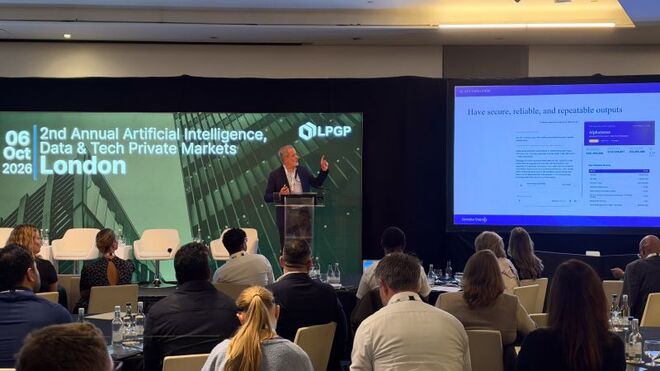
Juan Manrique, Chief Innovation Officer at Investor Pointe, presenting at the 2nd Annual LPGP Connect AI, Data and Private Markets London Conference on October 6th, 2026.
AI is already helping private equity teams complete certain tasks in hours that previously took weeks. Yet many firms are finding that adopting tools such as large language models (LLMs) has not delivered the results they expected. The difficulty often lies in the quality and accessibility of their data, as well as the processes and people needed to use the technology effectively.
Speaking at LPGP Connect last month in London, I set out what Investor Pointe has learned working with fund managers, wealth managers and fund administrators. The discussion covered where AI is already making a difference, why implementation can be difficult and how firms can approach adoption over the next 12 months.
Where AI adds value across the fund lifecycle
AI can streamline operations end to end. In our work with clients, four areas stand out as particularly useful applications.
- Sourcing and screening. Scan market and proprietary data to surface targets, and score inbound deal flow against the fund's thesis. This matters most where teams handle large volumes of data, such as secondaries, where every deal carries extensive information on underlying assets.
- Due diligence. Summarise data rooms, contracts and CIMs, run evaluation models, and flag risks and inconsistencies for the deal team to verify. A process that traditionally takes two to three weeks can be reduced to hours.
- Portfolio value creation. Monitor KPIs across holdings in near real time, spot underperformance early and share playbooks across portfolio companies.
- Fund operations and investor relations. Automate reporting, valuation support and LP queries, and draft quarterly letters and DDQ responses for review.
With sustained pressure on management fees, these gains go directly to the cost of running a fund. They also provide investment and operating teams more time to focus on the work that requires their experience and judgement.
Why reliable data matters
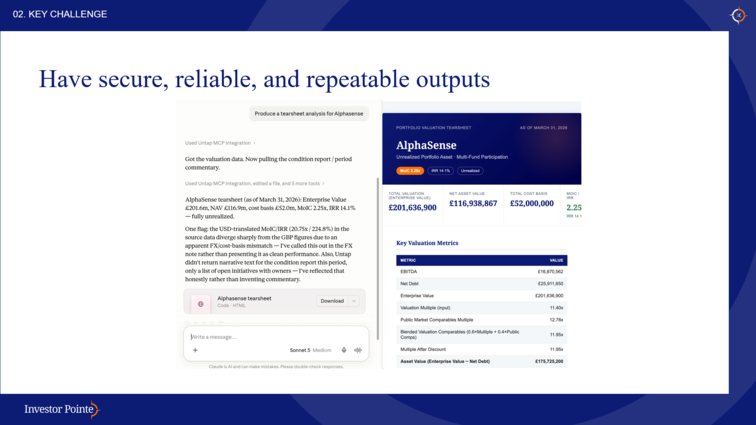
Today's AI assistants are remarkable. But in financial services, one problem undermines them quickly. Ask the same question twice and you may get two different answers. When a valuation, an IRR or an LP's commitment is at stake, that is not acceptable.
Outputs must be secure, reliable and repeatable. In our live demonstration, an assistant connected to a fund's governed data produced a full portfolio valuation tearsheet in moments. More importantly, it flagged an FX and cost-basis mismatch in the source data instead of presenting it as clean performance, and it said plainly where commentary was missing rather than inventing it. This is the kind of behaviour firms need to be able to rely on. The assistant must work from agreed data sources, follow consistent calculation rules, and recognize when the information is incomplete.
The solution is to go back to basics. Data is the fuel for the AI engine, and AI is only as good as the data it can reach.
Build the data foundation first
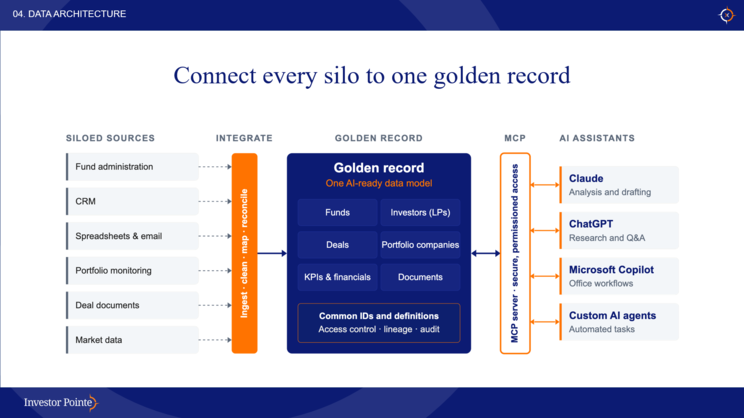
In most funds, critical data still sits in silos across fund administration and accounting systems, CRM, middle-office tools, portfolio monitoring, spreadsheets and inboxes. On top of that sits unstructured information such as board packs, GP quarterly reports and deal documents, plus market data.
- Centralize. Bring deal, fund and portfolio data into one governed repository instead of scattered files. In one current client project, this means migrating 40 to 45 million data records.
- Standardize. Agree a common taxonomy so that a portfolio company in the accounting system is exactly the same company in the middle office and the front office. In most firms today, it is not.
- Govern. Set access controls, lineage and audit trails, so that the investment committee and LPs can trust every output.
Once data is ingested, cleaned, mapped, normalised and reconciled, it forms a golden record: one AI-ready data model covering funds, investors, deals, portfolio companies, KPIs, financials and documents. AI assistants such as Claude, ChatGPT, Microsoft Copilot or custom agents then connect to it through a secure, permissioned interface called an MCP server. In simple terms, the MCP server is a controlled gateway. It lets the assistant ask questions of your data and know exactly where to find each answer, while respecting who is allowed to see what.
Skip this step and any AI initiative will struggle. People will not trust the answers, and the initiative will fade.
Put the right operating model in place
Technology is only as good as the people who use it. Without the right culture and governance, firms end up with a free-for-all of shiny tools, disappointed users and friction between teams.
From our experience, firms need clear ownership of AI initiatives, people who understand both the technology and the business, and agreed rules for how it can be used. Four considerations are particularly important.
-
Leadership ownership. A partner-level sponsor owns the AI agenda, ties it to fund strategy and reports progress to the investment committee. Many funds are now appointing a dedicated lead for this.
-
Talent and skills. Appoint a data and AI lead, and train deal and operating teams to use the tools in their daily workflows.
-
Guardrails. Protect confidential deal and LP data, require human review of outputs and document how AI is used. These policies should also be built into how the AI connects to the golden record.
-
Build, buy or partner. Buy proven platforms for common workflows, and reserve custom builds for where the fund has a proprietary edge.
The last point is becoming particularly relevant as AI makes it easier for teams to develop their own applications. Teams are now creating "vibe-coded" apps with AI agents, often producing impressive prototypes that can be difficult to maintain or govern once other people begin relying on them.
These applications can create a form of shadow IT, where tools are introduced without the controls, documentation or support expected of enterprise systems. A fund's core business is raising capital and deploying it for the best returns, not running IT. Someone has to maintain, scale and understand every tool, and that should not be your most expensive people.
A practical 12-month approach
Firms do not need to overhaul their entire operation before they can start using AI. A phased approach allows them to test specific applications, establish the necessary controls and expand as they gain confidence in the results. The following provides a possible roadmap, although the pace will depend on the firm's existing data and systems.
-
Foundation (months 0–3). Audit data sources and begin creating the golden record, starting with the low-hanging fruit of accounting data held by the fund administrator. Pick two or three high-value use cases, set an AI policy and appoint a sponsor.
-
Pilot (months 3–6). Deploy with one deal or portfolio team, measure time saved and output quality, and refine workflows before rollout.
-
Scale (months 6–12). Roll out successful applications across funds and teams, extend proven tools to portfolio companies where appropriate, and track ROI and report it to LPs.
Starting with a single fund or use case also makes the results easier to assess. Teams can see how much time is being saved, whether outputs are accurate and where manual intervention is still required. As more data is brought into the same environment, those applications can be extended across additional funds and workflows.
Making AI part of the operation
Private equity firms have plenty of potential applications for AI, but choosing a tool is only one part of the work. The harder questions concern how information is managed, who is responsible for the technology and whether teams can trust its outputs enough to use them in their daily decisions.
The most useful starting point is often a specific operational problem. That might be reducing the time spent reviewing due diligence documents, making portfolio information easier to access or responding to investor requests more quickly.
Once a firm can demonstrate that an application works reliably, it has a stronger basis for extending it elsewhere.
Over time, that is how AI becomes part of the way a fund operates, with measurable improvements in efficiency and more time available for investment teams to focus on decisions that require human judgement.
How Investor Pointe can help
Investor Pointe combines intelligent technology with expert human services for private markets. Our platform supports fund design and pre-launch, fundraising and digital onboarding, investor servicing, portfolio management, and insights and data optimisation, with agent-driven data pipelines that ingest, reconcile and activate fragmented portfolio data in real time.
We work alongside lean fund teams to centralise their data, build the golden record and connect it securely to the AI tools they already use, so they can focus on what they do best: raising capital and generating returns.
Ready to make AI work for your fund? Book a free consultation with our team today to discuss our solutions.